As winter continues to shape the rhythm of life in the Sierra, the February 2026 real estate market in Truckee and the greater North Lake Tahoe region delivered a nuanced set of signals that underscore the complexity, and resilience, of our mountain housing market. While headline numbers may suggest a cooling moment relative to January, a deeper analysis reveals a market that is stabilizing, recalibrating, and quietly preparing for the momentum that typically arrives with the spring selling season.
Sales Activity & Market Pace
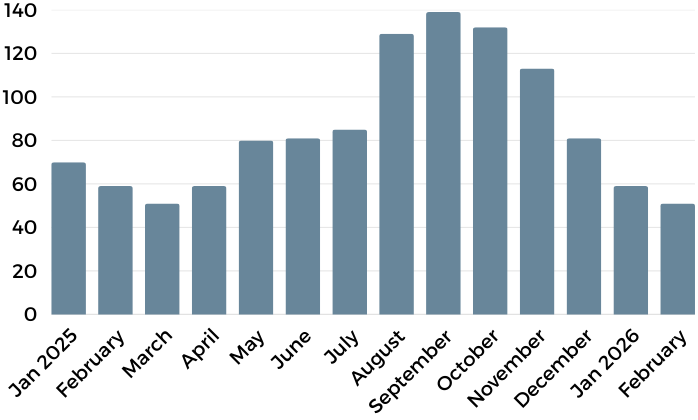
From a transaction standpoint, February concluded with 51 closed sales, representing a 14% decline from January but also a 14% increase compared to February of last year. This dual movement tells an important story: month-to-month fluctuations are normal in a seasonal resort market like Tahoe, but the year-over-year growth signals that buyer demand remains fundamentally healthy. Winter activity can often hinge on snowfall patterns, travel behavior, and buyer timing, and February’s numbers reflect a market still actively transacting despite broader economic headlines.
Month-over-Month Total Sales Transactions
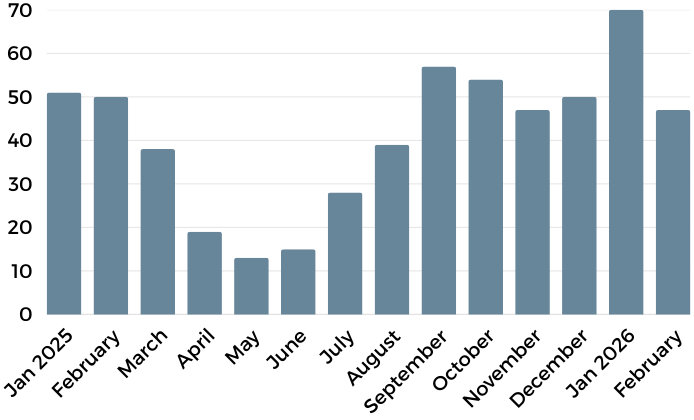
At the same time, buyer engagement appears to be improving, as reflected in a meaningful shift in marketing timelines. Median days on market dropped to 47 days, down from 70 days in January and effectively identical to February of last year. This decline suggests that well-positioned homes, those priced appropriately and presented effectively, are still moving through the market at a healthy pace.
Median Days on Market
Pricing & Value Trends
Pricing metrics require a bit more context to interpret accurately. The median sold price for February came in at $1,550,000, representing a 32% drop from January and a 22% decline compared to the same month last year. At first glance, that figure may appear dramatic; however, the shift is largely attributable to the composition of sales rather than a meaningful drop in property values. January experienced an unusually high concentration of luxury sales above $5 million, which temporarily inflated the overall median. February, by comparison, saw fewer transactions in that ultra-high-end segment. When adjusted for the mix of properties sold, values across most price tiers have remained relatively consistent with broader market expectations.
Month-over-Month Sold to List Prices
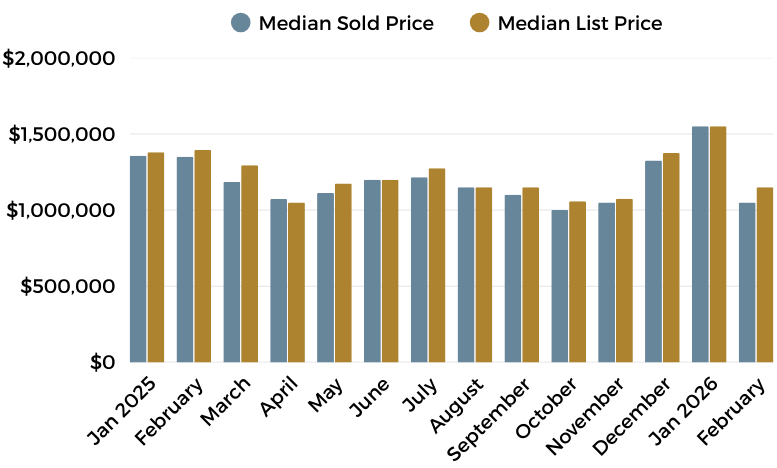
Another important indicator of buyer behavior is the relationship between asking price and final sale price. Homes sold at an average of 8.7% below list price in February, a statistic that reflects continued negotiation between buyers and sellers but remains well within the normal range for a balanced Tahoe market. For perspective, resort markets often see wider negotiation bands than primary metropolitan markets, particularly during winter months when inventory selection can vary widely.
Inventory & Market Balance
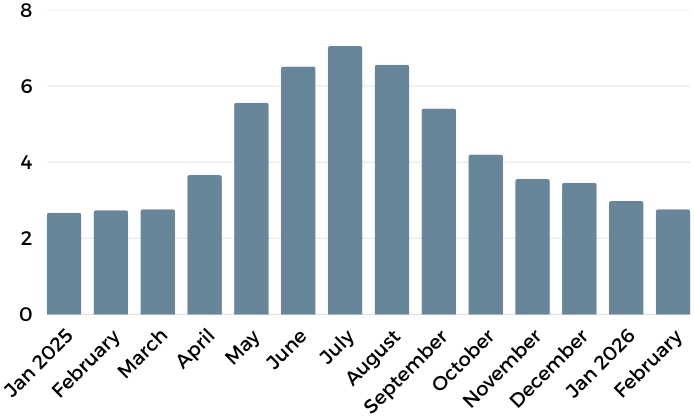
On the supply side, the story continues to center on constrained inventory. Available listings declined another 7.4% from the prior month, leaving total inventory essentially flat compared to this time last year. The market currently sits at 2.76 months of inventory, a level that historically signals a market approaching the bottom of its seasonal supply cycle. In the Truckee–Tahoe region, listing inventory typically reaches its lowest point during late winter before beginning to rebuild in April as homeowners prepare properties for the spring and summer buying season.
Months of Inventory
Incline Village / Crystal Bay Market Update
The February 2026 real estate market in Incline Village delivered a strong set of signals that reinforce the long-term appeal of the Nevada side of Lake Tahoe. Median home prices climbed to $2,070,000, representing a 33.5% increase compared to February 2025 and a remarkable 57.4% jump from January 2026, underscoring renewed demand for Tahoe’s tax-advantaged luxury housing market. Transaction activity followed suit, with 20 closed sales, up 66.7% year-over-year and month-over-month, signaling that motivated buyers are continuing to move forward despite broader national economic uncertainty. Even as the market navigates winter seasonality, new listings rose 25% from January, bringing active inventory to 112 homes, a 13.1% increase compared to last year, which is gradually improving selection for buyers entering the market.
From a performance standpoint, homes sold at 95.0% of list price, demonstrating that well-positioned properties continue to command strong interest while still allowing room for negotiation typical of a balanced luxury market. Median days on market reached 88 days, modestly higher than January but still largely in line with historical norms for Incline Village’s high-end inventory. Pricing power also remained evident on a price-per-square-foot basis, with the median sold price reaching $849 per square foot, up 26.7% month-over-month and 10.7% year-over-year. Meanwhile, months of supply declined to 5.6 months, down 34.8% from the prior month, suggesting that while inventory is improving, the market still leans toward equilibrium rather than oversupply. Taken together, the February data reinforces a clear narrative: Incline Village continues to operate as one of the most resilient and desirable luxury real estate markets in the western United States, where lifestyle, tax advantages, and long-term wealth preservation continue to attract buyers seeking both investment value and the unmatched quality of life offered along Tahoe’s North Shore.
Of course, local real estate does not exist in a vacuum. National and global economic developments are shaping buyer psychology as we move deeper into 2026. Inflation had been moderating and mortgage rates had briefly dipped below the 6% threshold, offering a glimpse of renewed affordability and sparking optimism across the housing sector. However, recent geopolitical tensions stemming from the conflict involving Iran have pushed global oil prices higher, reigniting concerns around inflation. In response, investors seeking safety have shifted capital into bonds, causing mortgage rates to climb back above 6%.
As We Prepare to Spring Forward
While these macroeconomic developments create short-term volatility, it’s important to remember that lifestyle-driven resort markets like Truckee and North Lake Tahoe operate on slightly different fundamentals than urban housing markets. Many buyers here are purchasing second homes, generational retreats, or long-term lifestyle investments rather than purely rate-sensitive primary residences. As a result, Tahoe’s real estate market often demonstrates remarkable resilience during periods of broader economic uncertainty.
Looking ahead, there is growing optimism as we approach the transition from winter into the spring listing season, historically one of the most active periods of the year for Tahoe real estate. Inventory is poised to expand, new buyers will begin planning summer visits, and many sellers will take advantage of improved weather and longer daylight hours to bring homes to market.
In many ways, February feels like the quiet moment before the next movement of the Tahoe real estate symphony begins. The snow will eventually give way to sunshine, ski boots will trade places with hiking shoes, and the region will once again welcome the steady arrival of buyers drawn to the lifestyle that makes this mountain community so special.
If early indicators are any guide, 2026 is shaping up to be a year defined not by dramatic swings, but by thoughtful recalibration, steady demand, disciplined pricing, and continued confidence in the long-term value of owning property in Truckee and North Lake Tahoe. And as always, markets evolve quickly in resort destinations, which is why having clear data, local insight, and strategic guidance remains more important than ever.
For buyers and sellers navigating this unique market, the opportunities ahead are real…and the story of 2026 is only just beginning.